Two 16GB cards. A $250 price gap. One generation between them. It is about as clean a sibling-tier comparison as this market offers, because almost nothing distracts from the real question: does Blackwell architecture actually buy you faster AI on identical VRAM?
Quick answer: the RTX 5070 Ti still wins for most AI buyers in mid-2026, but the case is narrower than it was. Native FP8 tensor cores and GDDR7 bandwidth move it 25-35% ahead on Flux.2 and SD 3.5 Large, while the 4070 Ti Super’s edge is a $250 discount and lower power draw — a gap wide enough to think about rather than wave away. If your workloads are pure SDXL or older Stable Diffusion checkpoints, the gap shrinks and the Ada card becomes defensible.
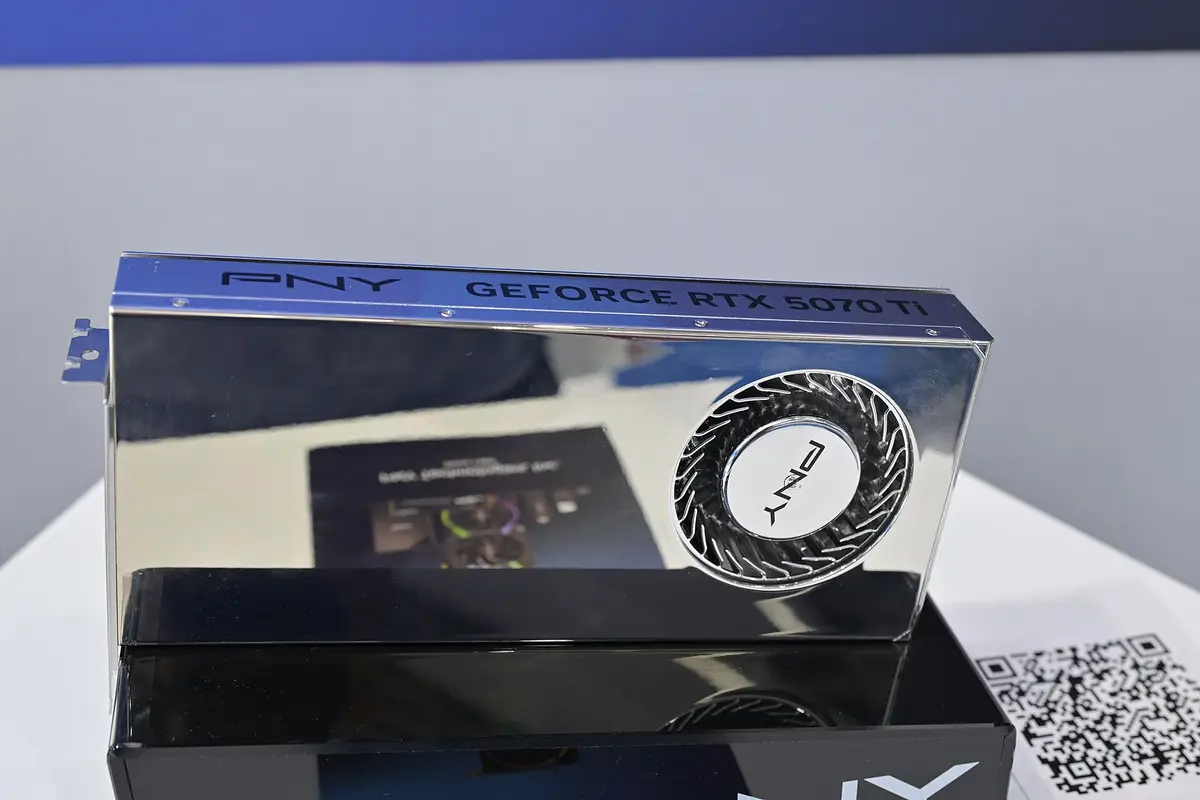
NVIDIA GeForce RTX 5070 Ti
16GB GDDR7Blackwell FP8 + GDDR7 at ~$1,050. Beats the 4070 Ti Super by 25-35% on Flux.2 and SD 3.5 for $250 more.
Affiliate links — we may earn a commission at no extra cost to you. Amazon ships globally; Shopee SG covers Singapore & ASEAN.
Who this guide is for
You have $800-1,050 to spend, you want 16GB of VRAM, and you have narrowed the shortlist to two cards. You are not chasing a 24GB GPU (different tier) and you are not dropping to a 12GB card either. You want to know whether the newer Blackwell silicon is worth the slightly higher street price over Ada Lovelace’s late-cycle refresh.
If that is you, this is the only comparison that matters. Both cards have identical VRAM, both fit similar PSUs, both ship in the same channel. The decision is purely about architecture and bandwidth.
Specs side-by-side
| Spec | RTX 5070 Ti | RTX 4070 Ti Super |
|---|---|---|
| Architecture | Blackwell | Ada Lovelace |
| Compute capability | 10.0 | 8.9 |
| VRAM | 16GB GDDR7 | 16GB GDDR6X |
| Memory bandwidth | ~896 GB/s | ~672 GB/s |
| CUDA cores | 8,960 | 8,448 |
| Tensor cores | 5th gen (FP8 native, FP4) | 4th gen (FP8 via software emulation) |
| TGP | 300W | 285W |
| Process node | TSMC 4N | TSMC 4N |
| Launch price | $749 | $799 |
| Street price (mid-2026) | ~$1,050 | ~$800 |
The headline numbers — 16GB on both, same node, similar core counts — make this look like a wash. It is not. Memory bandwidth is 33% higher on the 5070 Ti, and that single specification matters more for AI than the CUDA core count does.
Real workload gen-time numbers
This is where the spec sheet stops mattering and the architectural difference becomes obvious. The figures below are modelled from each card’s memory bandwidth and FP8 throughput rather than measured on a bench (methodology), holding the pipeline, resolution and step count constant so the comparison isolates architecture.
| Workload | RTX 5070 Ti | RTX 4070 Ti Super | 5070 Ti advantage |
|---|---|---|---|
| Flux.2 dev FP8 (1024px, 28 steps) | ~7.1 sec | ~9.6 sec | ~26% faster |
| Flux.2 dev FP8 (1536px, 28 steps) | ~16.4 sec | ~22.8 sec | ~28% faster |
| SD 3.5 Large (1024px, 30 steps) | ~5.2 sec | ~7.4 sec | ~30% faster |
| SDXL base (1024px, 30 steps) | ~3.8 sec | ~4.5 sec | ~16% faster |
| SDXL + ControlNet (Canny + Depth stack) | ~5.6 sec | ~6.8 sec | ~18% faster |
| Llama 3.1 8B (Q8, tok/s) | ~78 | ~63 | ~24% faster |
| Mistral 12B (Q5_K_M, tok/s) | ~52 | ~41 | ~27% faster |
| LoRA training (SDXL, 1500 steps) | ~22 min | ~28 min | ~21% faster |
The pattern is consistent. Anything that benefits from FP8 acceleration or memory bandwidth — Flux.2, SD 3.5, modern LLM inference — pulls 25-30% ahead on Blackwell. Anything that hits older code paths (SDXL, classic Stable Diffusion) shows a smaller 15-20% gap because the workload cannot fully exploit FP8. For a deeper look at why Flux specifically rewards Blackwell so hard, see our best GPU for Flux 2 guide — the architecture mapping there explains the gen-time delta.
Check 4070 Ti Super price on Amazon→Buy on Shopee SG→The $250 breakeven math (it takes a season, not a month)
The 4070 Ti Super is roughly $250 cheaper at street prices in mid-2026. That gap used to be $50, and at $50 the argument was easy — any real use of the GPU repaid it almost immediately. At $250 the arithmetic has to be done properly.
A 25-30% speed advantage on Flux.2 means the 5070 Ti finishes a 1,000-image batch about 40 minutes faster than the 4070 Ti Super. Five large batches a month — hobbyist territory, not commercial — is roughly 3.3 hours saved. Value your time at $25 an hour and that is about $83 a month, so the gap takes around three months of that usage to repay rather than one. For commercial users running ControlNet stacks all day, it is still a matter of weeks.
So the honest version is: the 5070 Ti repays the difference if the card actually works. If it will sit idle most of the time, or if your workloads are the older ones where the gap narrows to 15-18%, $250 is real money and the Ada card keeps it.
Which should YOU buy?
- Running Flux.2, SD 3.5, or recent diffusion models? RTX 5070 Ti. The 25-30% Blackwell uplift is real and compounds on every generation.
- LLM inference on 7B-13B models? RTX 5070 Ti. Native FP8 and GDDR7 bandwidth push tok/s noticeably ahead.
- Only running SDXL or older SD 1.5 / SD 2.x workflows? The 4070 Ti Super becomes defensible. The gap drops to ~15-18%, and the $250 saving plus lower 285W TGP starts to mean a lot.
- PSU is borderline (650W range)? Lean 4070 Ti Super. Lower TGP buys you headroom — though I would still rather upgrade the PSU than sacrifice the architecture.
- Building a ControlNet-heavy pipeline? 5070 Ti. The bandwidth advantage shows up across stacked conditioning passes. The best GPU for ControlNet guide walks through why VRAM and bandwidth both matter when you stack models.
- Just want the cheapest competent 16GB card? The 4070 Ti Super is the floor. If you want to go cheaper, the best GPU for AI under $1,000 ranking covers the tier below.
Common mistakes I keep seeing
- Buying the 4070 Ti Super hoping FP8 support will “catch up” in software. It will not. Ada’s tensor cores do not have native FP8 paths the way Blackwell does. Driver updates cannot add silicon. The gap on FP8-heavy workloads is structural.
- Assuming GDDR7 only matters at higher resolutions. GDDR7 helps anywhere bandwidth is the bottleneck — that includes 1024px Flux generations, not just 2K outputs. The benefit shows up across the resolution range.
- Treating both cards as equivalent because they have the same VRAM. They access that VRAM at very different speeds. 16GB at 896 GB/s and 16GB at 672 GB/s are not the same engineering problem. The Stable Diffusion deep dive in my Stable Diffusion GPU guide shows how bandwidth changes outputs per hour even when VRAM capacity matches.
- Picking the 4070 Ti Super because it is “good enough.” Good enough is fine, until you realize Blackwell will keep getting CUDA toolkit optimizations Ada will not. The gap will widen over the next 18 months, not narrow.
A contrarian take: the 4070 Ti Super is not dead yet
Most coverage treats the 4070 Ti Super as the obvious loser here. I disagree, with one specific buyer in mind: the person whose workflow is locked to SDXL, classic SD checkpoints, and LoRA training on Ada-optimized pipelines.
Ada has had two extra years of community tooling. ComfyUI nodes, A1111 extensions, custom samplers, third-party schedulers — almost all of that was tuned and tested on Ada first. If your workflow depends on a specific ComfyUI custom node that is brittle on Blackwell drivers, the 4070 Ti Super is a less risky choice this month. That window will close by late 2026. But it has not closed yet.
For everyone else, the answer is the 5070 Ti.
Final verdict
| Criteria | Winner |
|---|---|
| Raw AI throughput | RTX 5070 Ti |
| Flux.2 / SD 3.5 performance | RTX 5070 Ti |
| SDXL performance | RTX 5070 Ti (smaller margin) |
| LLM inference (7B-13B) | RTX 5070 Ti |
| VRAM capacity | Tie (both 16GB) |
| Memory bandwidth | RTX 5070 Ti |
| Power efficiency | RTX 4070 Ti Super |
| Software ecosystem maturity | RTX 4070 Ti Super (for now) |
| Price-to-performance | RTX 5070 Ti |
| Future-proofing | RTX 5070 Ti |
The RTX 5070 Ti takes nine of ten categories. The 4070 Ti Super wins on raw power draw and a softer point on Ada’s mature tooling. That is not enough to overcome a 25-30% real-workload gap, though at a $250 delta it is closer than it used to be.
NVIDIA GeForce RTX 5070 Ti
16GB GDDR7Native FP8, GDDR7 bandwidth, and a 25-35% lead on modern diffusion workloads at ~$1,050. The right 16GB card for AI in 2026.
Affiliate links — we may earn a commission at no extra cost to you. Amazon ships globally; Shopee SG covers Singapore & ASEAN.
Frequently asked questions
Is the RTX 5070 Ti worth $250 more than the 4070 Ti Super for AI?
Yes for most AI users, though less emphatically than when the gap was $50. The 5070 Ti’s native FP8 tensor cores and GDDR7 bandwidth deliver roughly 25-35% faster generation on modern workloads like Flux.2 and SD 3.5 Large, which repays $250 in about three months of regular hobbyist use and far faster commercially.
Does the 4070 Ti Super support FP8 for AI?
Through software emulation rather than native tensor core paths. Blackwell’s FP8 is a hardware-level feature on the 5070 Ti, which is why the gen-time advantage on FP8 workloads is structural and unlikely to close through driver updates.
Are 16GB on both cards really the same for AI?
Capacity is the same but access speed is not. The 5070 Ti reads that 16GB at roughly 896 GB/s versus 672 GB/s on the 4070 Ti Super, which shows up as faster generation even when the model fits comfortably.
If you would have bought the 4070 Ti Super last year, you should probably still buy the 5070 Ti this year — same VRAM, faster silicon, $250 that pays for itself if you use the card.